What you will be able to do
- Explain what the evaluator is scoring when you measure a pulse or count respirations.
- Find the radial pulse with the right fingers, on the right side of the wrist, every time.
- Count pulse and respirations for one full minute, and say why a shorter count fails.
- Record a pulse within 4 beats and respirations within 2 breaths of the nurse's reading.
- Do the Indirect Care steps that are scored inside every skill.
- Document on the Measurement Form before you say the word "done."
- State the normal adult ranges the written test asks for.
Your resident's vital signs are the story their body is telling. On test day, two of them can be on your skills list: the radial pulse and respirations. The evaluator takes the same measurement you do. Your number has to land close to theirs. This module shows you exactly how close, exactly how to get there, and the three mistakes that fail more candidates than anything else.
1.1Why this module comes first
Here is a number that should change how you study. On the Prometric skills test, the skill with the lowest pass rate of all twenty-two is measuring and recording a pulse. Only 74 out of 100 candidates pass it. Handwashing, by comparison, passes 97 out of 100.
Now the part that matters. The people who fail the pulse skill almost all know how to take a pulse. They have done it in class. They have done it on family. They fail on one of three things:
- The count. They count for thirty seconds and double it. Prometric lists "Counting less than one minute" as a mistake, word for word.
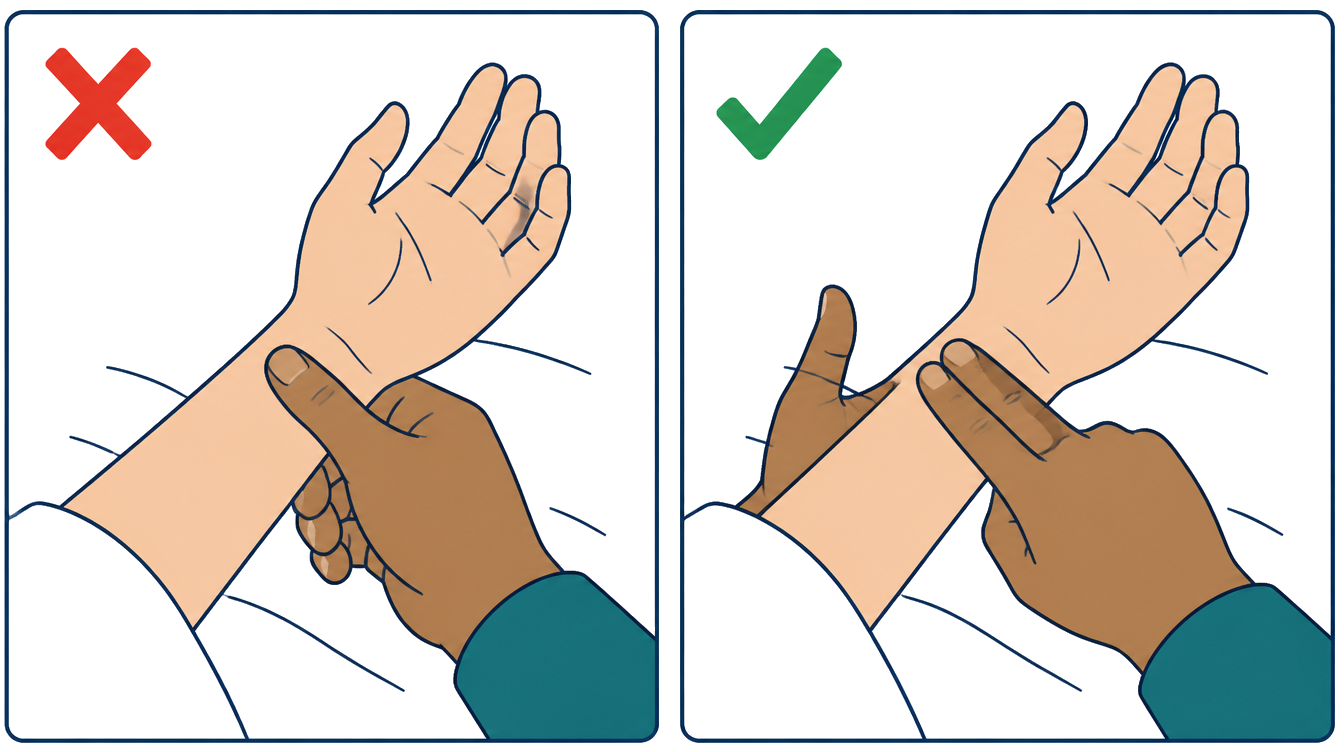
- The fingers. They use a thumb, or they press the middle of the wrist instead of the thumb side.
- The paperwork. They get the number right and then say "I'm done" before they write it down.
None of those is a nursing problem. Every one of them is a test-day problem, and every one of them is fixable in an afternoon. The 26 who fail mostly fail on those three things, and you are about to fix all three.
1.2What the evaluator is actually scoring
On test day you perform five skills. Two are the same for everyone: handwashing lavado de manos and Indirect Care cuidado indirecto. The other three are assigned to you. Pulse and respirations are two of the twenty-two skills that can be assigned. You are scored on all five.
For pulse and respirations, the nurse evaluator measures the same thing on the same person at the same time. Then they compare your number on the Measurement Form hoja de registro with theirs. The rule is simple and it is not negotiable:
Here is what that looks like. The nurse counts 80. Anything from 76 to 84 passes. A count of 75 does not, even though it is a perfectly normal pulse.
Land inside that range and you have hit the checkpoint. Prometric does not publish how much each checkpoint is worth, so treat this one as the one you cannot miss: it is the checkpoint the whole skill is built around, and good technique does not put a number back inside the range. This is why the count is everything. A short count that gets doubled can easily drift five or six beats from the nurse's full-minute count, and five is outside four.
1.3Measure and record the radial pulse
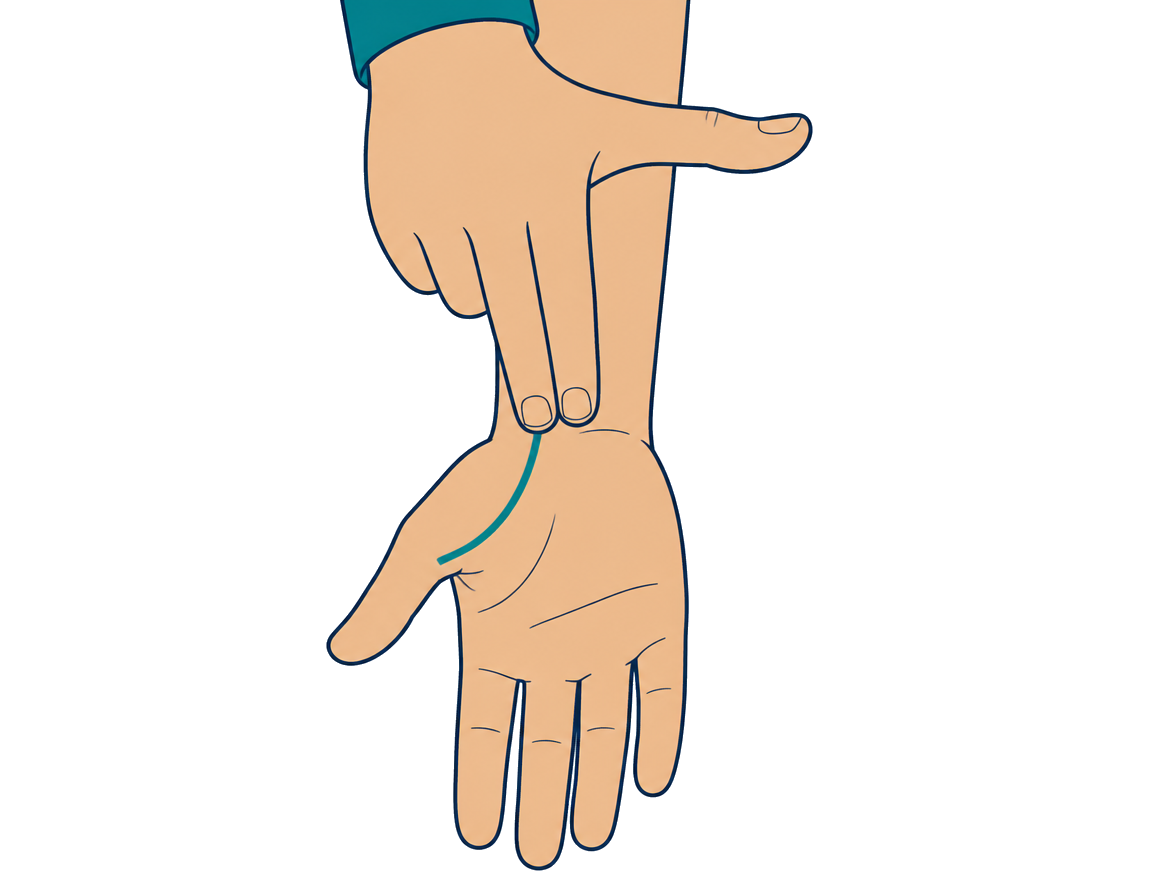
The radial pulse pulso radial is on the thumb side of the wrist, just below where the hand begins. You feel it with the pads of your index and middle fingers dedos índice y medio. Never the thumb. Your thumb has its own pulse and you will end up counting yourself.
The scored checkpoints, word for word
These are Prometric's checkpoints for this skill. The first two and the last five are Indirect Care steps, covered below. These are the ones in between. Prometric numbers them 3 to 7 on its own form:
- Support resident's arm in manner to avoid dangling while pulse is taken?
- Use fingers (not thumb) to take pulse?
- Places fingers on wrist at radial pulse to measure pulse rate?
- Count pulse for one full minute?
- Record resident's pulse rate on Measurement Form within +/- 4 beats per minute of nurse's measurement?The number they compare
How to do it so it holds up under nerves
- 1Greet, introduce, explain."Good morning, Mrs. Lopez. I'm Ana, your nursing assistant. I'm going to check your pulse. It won't hurt. May I hold your wrist?" Every sentence there is a scored Indirect Care checkpoint.
- 2Support the arm.Rest the resident's forearm on the bed, the armrest, or your own hand. An arm hanging in the air is a scored miss, and a tense arm makes the pulse harder to feel.
- 3Find it with two fingers.Index and middle fingertips together on the thumb side of the wrist. Press gently. Too hard and you flatten the artery and lose it. If you cannot feel it in ten seconds, move your fingers a little toward the thumb, not toward the middle.
- 4Look at the clock and start on a beat.Bring your own watch with a second hand. Do not count on a wall clock being where you can see it. Start counting when the second hand hits a number you will remember.
- 5Count for one full minute.Sixty seconds. Count every beat. Do not stop at thirty and double. Do not stop at fifteen and multiply. If you lose count, start the minute over. A restarted minute passes. A doubled half-minute is a listed mistake.
- 6Wash, then write, then speak.Take your fingers off. Wash your hands, or say out loud that you are washing them. Prometric's own mistakes list includes "not mentioning or attempting to wash hands at the correct time," so saying it counts. Write the number on the Measurement Form. Then tell the evaluator you are finished.
- Fingers in the middle or ulnar side of wrist
- Using thumb instead of fingers to check pulse
- Counting more than one minute
- Counting less than one minute
- Counting 30 seconds and not multiplying total X 2
- Counting respiration instead of pulse
- Not documenting before saying done
→That is the free sample
You have just read the first three sections of Module 1. The rest of this module covers respirations, the seven Indirect Care checkpoints, the measurement form, the written-test questions, a practice routine, and a scored check. Module 2 is waiting behind it, and every later module is added as it ships.
Enroll for $149 Already enrolled? Sign in
One-time price, no subscription. Have an access code? Enter it at enrollment and there is nothing to pay.